
Room B
1970-1990. From the Wheel to the Tyre. Relief and Imprint
Peter Stämpfli
1970-1990. From the Wheel to the Tyre. Relief and Imprint
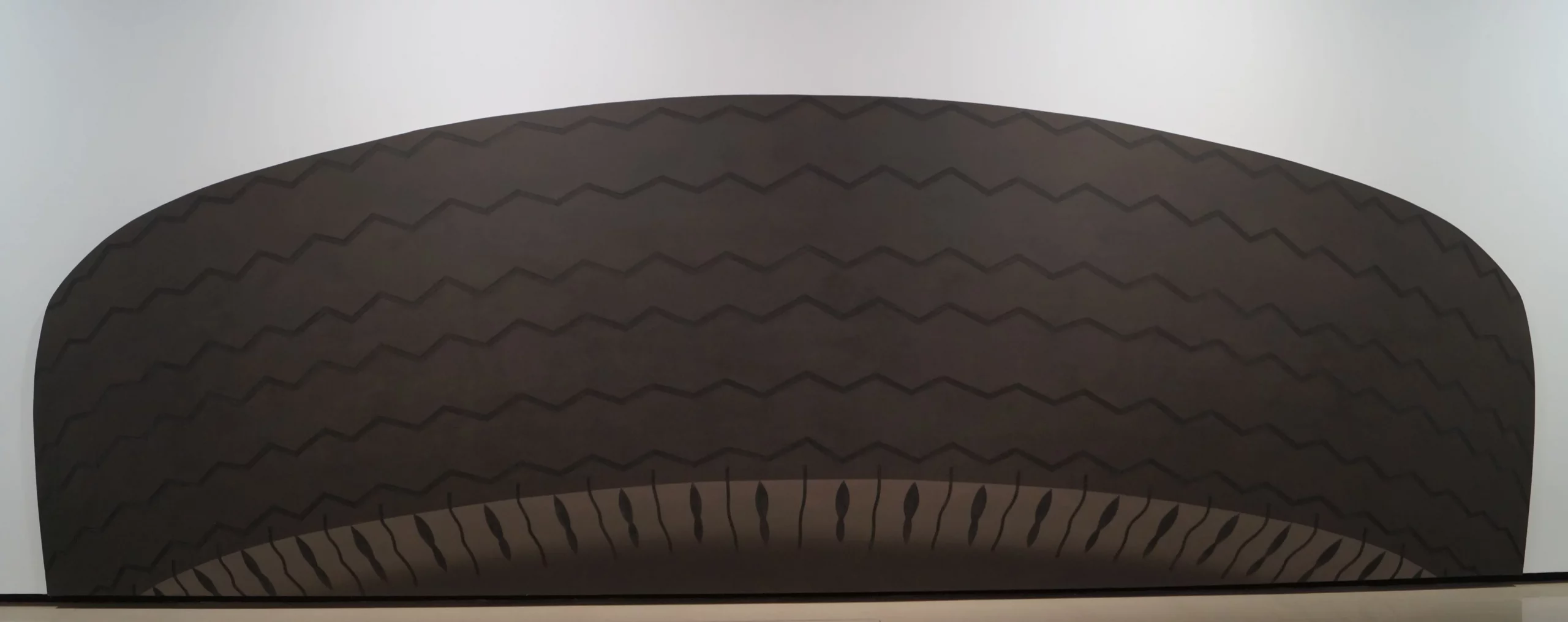
From 1970 to 1990, Peter Stämpfli’s work moved away from the inventory of everyday objects and gestures to focus on a single theme — the tyre and its geometry — a symbol and modern myth of mechanised society. Colour disappeared, replaced by tones of black and grey; the dimensions of the works expanded, and the large formats of paintings and sculptures projected themselves into the viewer’s space.
The contrast with the first room is total, and the dominance of blacks and greys creates a dense, rarefied atmosphere. Two large-format works stand out in particular: Polyester Cord (1970), with which Stämpfli represented Switzerland at the Venice Biennale that year, and Cavallino (1972), one of the works exhibited in his major show at the Palais des Beaux-Arts in Brussels. Two monumental canvases, six metres wide and two metres high, cut out and mounted on stretchers that follow the shape of the tyre. This makes the works detach slightly from the wall, advancing into the viewer’s space. Stämpfli had already experimented with this method of cutting and mounting the canvas — shaped canvas — in the work Rouge Baiser, which can be seen in Room A.
The third large-scale work is 195 VR 14 (1975). It is an enlargement of a fragment of the original tyre, almost square in shape, about three metres on each side, painted in two shades of black. The canvas is covered with elementary geometric signs — simple, almost single-cell units — organised into horizontal bands following the rhythm and logic of repetition. The result is the disappearance of any trace of figuration. We are already facing abstract images directly related to minimalism and constructivism.
From this period onward, Stämpfli expanded his work in several directions, experimenting with different techniques and traditional media such as charcoal and graphite drawing on paper. He also created sculptures and reliefs, some monumental, placed in public and open spaces, as shown in this room: one of them is the small white preparatory model of Empreinte de pneu S 155, a tyre imprint thirty metres long and three metres wide, produced between 1985 and 1990 in the Parc du Petit-Leroy in the Val-de-Marne department. This work, owned by the French State, will be installed in 2026 in the large sculpture park on the Île Seguin, on the Seine near Paris.
The room is completed by two versions of the sculpture 9 HDT 219 (1997), in black and white polyester, and the projections of the films Firebird (1969) and Ligne continue (1974).