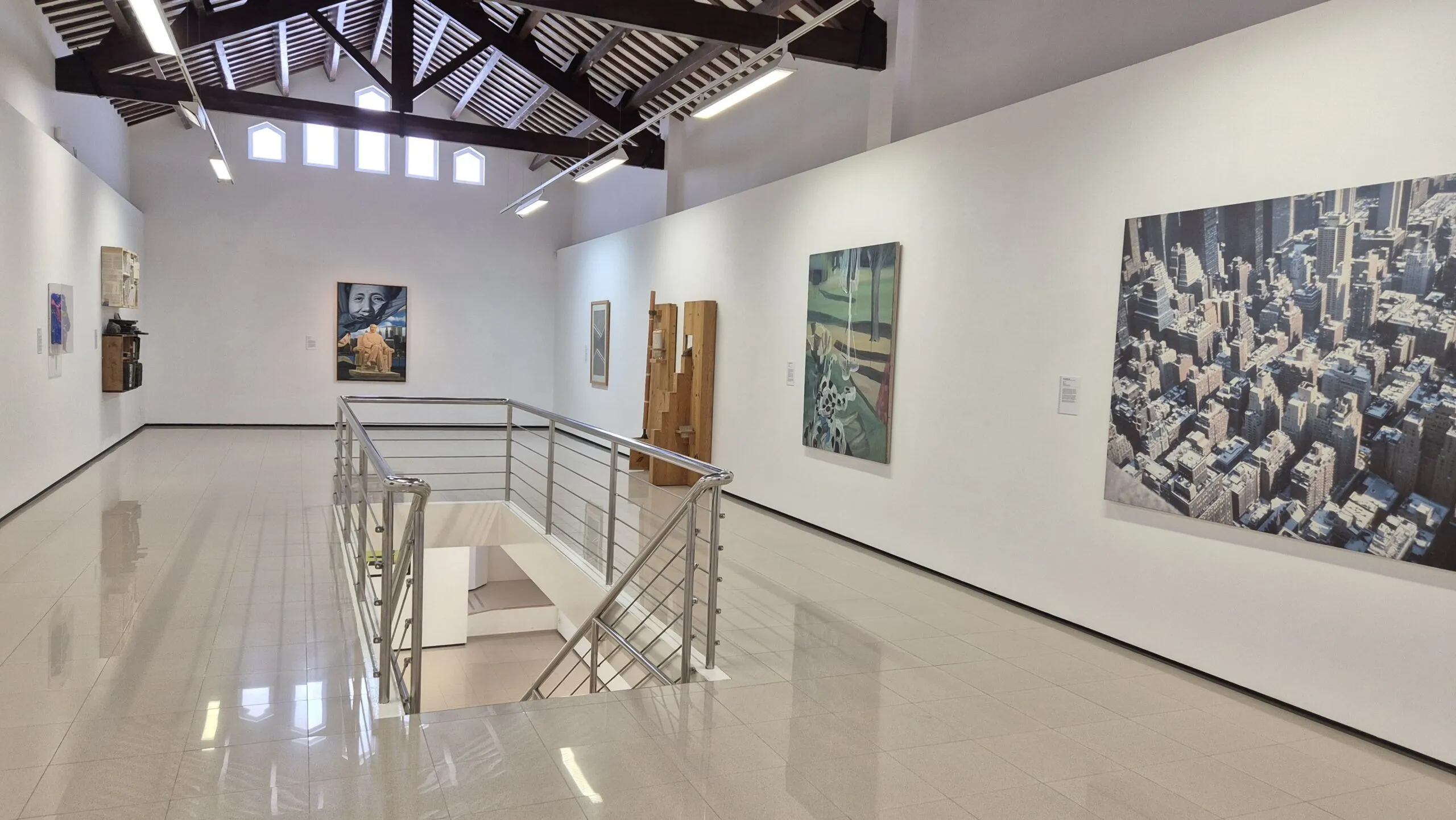

The exhibition ‘1965 – 2011’ presents 37 works from a plural collection of trends and styles
The Fundació Stämpfli presents 37 works from its contemporary art collection, in an exhibition of polyhedral trends, styles and themes, which can be seen until April 2025. Under the title 1965 – 2011, the exhibition unfolds in Rooms 1, 2 and 3 works by around thirty artists of diverse origins, who share having developed their careers in Paris from the 1960s onwards.
1965 – 2011 is the title of a proposal that frames the presentation between two dates. From 1965 comes the oldest work: Rue Lafayette (Ap19), a small format of torn posters on canvas by Jacques Villeglé, the most representative artist of affichisme. From 2011 is the most recent: Atmosphère chromoplastique N° 992, an acrylic relief on wood by Luis Tomasello, representative of Latin American optical kineticism and based in Paris since the 1960s.
Between these two dates, the more than thirty works that make up the exhibition engage in dialogue, presented as a discontinuous itinerary of the different trends of visual arts in the last third of the 20th century and the beginning of the 21st. Paris, as a cultural capital and magnet for artists, acts as the link: most of the artists present — French and from fourteen other countries — developed their careers in this city.
The exhibition is a plural proposal, allowing for a precise approach to the complete collection of the Fundació Stämpfli, created from the donations made by the artists or their descendants to the couple Pere and Anna Maria to build the current collection. With this presentation, the three rooms (two in the former Mercat del Peix and one in Can Mec) acquire a fully renewed appearance, with works that in several cases had never before shared a space.

The rooms:
Room 1 presents what can be considered “the other life of things”, the radical proposal of the 1960s by a generation of young artists who extracted banal objects from their natural environment and brought them into art galleries and museums as characters endowed with sufficient potential to provoke in the viewer a new and different aesthetic and social reflection. Next to these, geometry is shown—varied among itself—such as in the two works by Rocamora and Stämpfli, and the two by Mark Brusse, which introduce a parenthesis.
In this space, the first visited upon entering the exhibition, there are works by Mark Brusse, Gérard Deschamps, Erró, Marc Grandeschamps, Piotr Kowalski, Jean-Luc Parant, Pavlos, Antonio Recalcati, Peter Stämpfli and Joan Rocamora.

Room 2 presents a snapshot of the most heterogeneous side of the collection. The titles guide the viewer to question the images and discover what may lie behind puzzling allusions: to the impatience of a mythological figure; to the strange meeting of Goya and Jules Verne’s Nautilus; to a 19th-century painter, Auguste Radier, or the secret appearance of another from the 20th, Georges Mathieu; the landscapes and scenes created by the sun next to a pair of active volcanoes; the poetry of forgotten thoughts; the kiss characteristic of the final scene of a crime film; or a mother teaching her child to read — all complete the tour.
In this space there are works by François Arnal, Mark Brusse, Pierre Buraglio, Daniel Dezeuze, Konrad Klapheck, Ladislas Kijno, Jacques Monory, Antoni Taulé, Jacques Villeglé and A Sun Wu.

Room 3 presents another strong personality of the collection: geometric and kinetic abstraction. The works exhibited stem from the artists’ intention to find an identity between artistic laws and those of nature. Abstraction has an objective: “the expression of pure reality”, understood as the suppression of any visible form, whether of objects or of any form of nature.
The absolute contrast with this objective is given by three black-and-white photographs situated to the left of the entrance to the space. Halfway between the two positions stands the abstract composition made with construction material located at the centre of the room.
In this space there are works by Rafael Canogar, Horacio García Rossi, Claire – Jeanne Jezequel, Peter Knapp, Daniel Pommereulle, Sato Satoru, Luis Tomasello, Niele Toroni, Michael Warren and Joel-Peter Witkin.