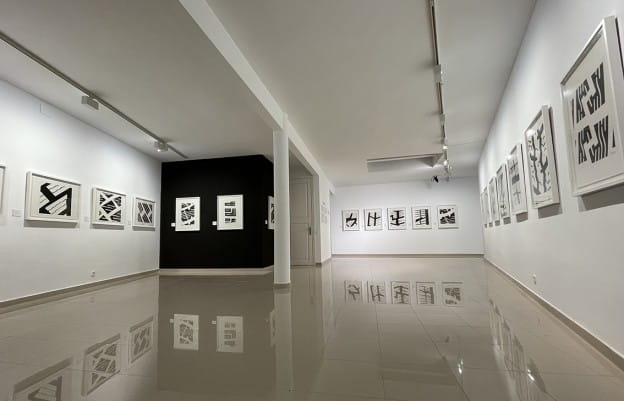

The exhibition ‘Vibrances’ shows black-on-white acrylics by the Swiss artist, accompanied by a selection of 30 works by artists from the collection’s holdings
The Stämpfli Foundation presents 21 recent works by Peter Stämpfli, made in acrylic paint and never before seen in Catalonia. They form the exhibition Vibrances, which opens on Saturday, 25 March, and can be viewed until 24 September in Room 3. Alongside Vibrances, the Foundation displays 30 works from its collection in Rooms 1 and 2, in a new presentation of its holdings.
In 2010, Peter Stämpfli began work defined by technical and conceptual austerity, which involved a more intimate reduction of format. Following his characteristic tyre motif as the theme of his work, the artist underwent a radical change from his previous period marked by colour, to delve into a series of works in black acrylic on white.
The works shown in Vibrances —a word which in French denotes a photographic effect of colour saturation— are expressed in an intense black on the white of Vélin d’Arches paper and refine an angular geometry that avoids horizontality and verticality. The contrast between the broader forms and the sinuosity and intermittence of the fine, short strokes conveys a sensation of movement and vibration, so that each image reflects a snapshot of the deformation or tension produced by a recent vibration.
The 21 paintings exhibited are part of a group of 51 works that Peter Stämpfli produced between 2010 and 2014. Part of the series was shown in 2017 in an art gallery in Paris. This is the first time they are exhibited in Catalonia.
New collection exhibition in Room 1. Parallel to Vibrances, the Foundation has renewed part of the permanent collection display. Room 1 presents works by thirteen artists of five nationalities from a generation who, in Paris in the late 1950s and early 1960s, shared concepts and principles.
Eight of them (Gianni Bertini, Mark Brusse, Henri Cueco, Gérard Fromanger, Peter Klasen, Jacques Monory, Bernard Rancillac, Peter Stämpfli and Jan Voss) were part of Narrative Figuration, which considered their images as isolated scenes from a broader story or narrative to be reconstructed by the viewer’s imagination.
It was a group that asserted the power of figuration, that art is contained in any object or situation, and that technique is itself an unlimited artistic language.
The other four artists in this Room 1 (Christian Jaccard, Peter Knapp, Jean Le Gac and Claude Viallat) represent an example of the creative capacity of the chosen artistic medium: for Jaccard, fire as pigment; for Knapp, the energetic incision on the photographic negative; for Viallat, the imprint of the same elemental form repeated throughout his career; and for Le Gac, personal biography transformed into a work of art through documents and images, real or fictional.
Room 2: collection holdings. Room 2 of the Foundation maintains the same display —with works from the holdings— presented last summer on the occasion of the previous exhibition by Peter Stämpfli. It is a selection of works and artists who chose to renew geometric abstraction or who ventured into the paths of minimalism, conceptual art, kinetic art, and the neo-avant-gardes. These include French artists Pierrette Bloch, Philippe Cazal, François Dufrêne, Jean-Jacques Lebel, Jean-Michel Meurice, Olivier Mosset, Jean-Michel Sannejouand, Pierre Tilman, Gérard Titus-Carmel and Jacques Villeglé; the Belgian Mark Brusse, the Catalan-American Tom Carr, the Venezuelan Carlos Cruz-Díez, the Italian Marco Del Re, the Argentine Antonio Seguí, the Korean Kim Tschang-Yeul and the Serbian-French Vladimir Velickovic.