
Stämpfli and Sitges
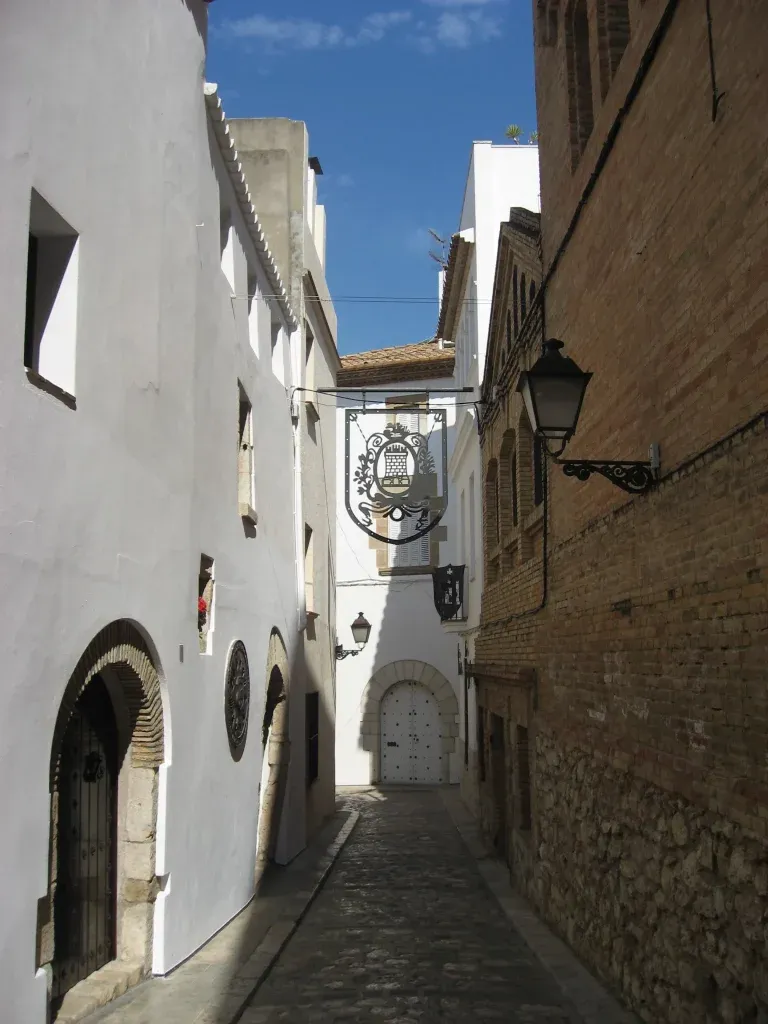
The relationship between Peter and Anna Maria Stämpfli and Sitges began immediately after their arrival in the town, when, in 1970/71, they acquired an old fisherman’s house on Carrer d’en Bosc, the oldest street in Sitges.
The personality of this narrow street, evoking an almost lost past, alerted the Stämpflis to the danger of the disappearance of its buildings—victims of tourist speculation, a sign of the times that, sixty years ago, was already beginning to take shape in Sitges.
Step by step, they acquired three adjacent properties where they established their residence. They respected the exterior, cleared the interior of partitions and other recent additions, preserved the diaphragm arches on the ground floor and, above all, left visible the section of the 14th-century wall that ran inside one of the houses. These constructions are difficult to date, probably from between the late 17th and early 18th centuries.
While renovating the houses, they became friends with Pere Serramalera, a doctor and neighbour on the same street, who introduced them to the Biblioteca, where they met Ramon Planes and Jacint Picas; through them, they were introduced to Josep M. Soler i Soler, owner and director of L’Eco de Sitges, and later to the members of the Grup d’Estudis Sitgetans. Fond of sailing, they also owned a racing boat in Aigüadolç, thus widening a very diverse circle of friends.
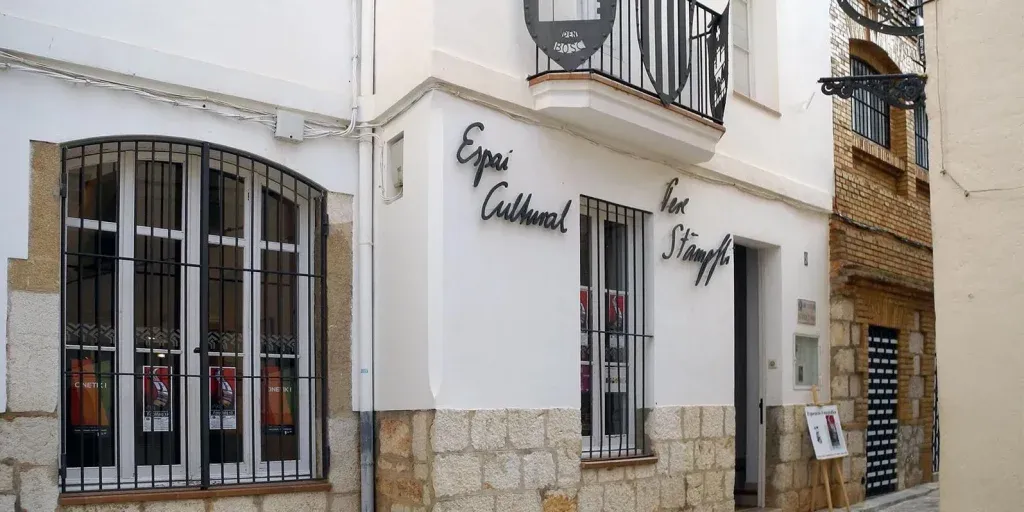
Later, they took over the house known as Can Mec, named after its former owning family. The building was completely restored and, under the name Espai Cultural Stämpfli, was donated to serve as the headquarters of the Grup d’Estudis Sitgetans. Finally, Can Serramalera became part of the project for the creation of a future foundation devoted to contemporary art.
El Carrer d’en Bosc
Until 1891, once the Mercat Vell was completed, the street connected the old Casa de la Vila, located on Carrer Major, with the town exit near the Barcelona gate leading to Platja de Sant Sebastià.
With the construction of the market, a section of the 14th-century wall and some houses at the upper part of the adjacent Carrer Major were demolished, and others were built; the new route was laid out at a right angle in the first part of the current street.
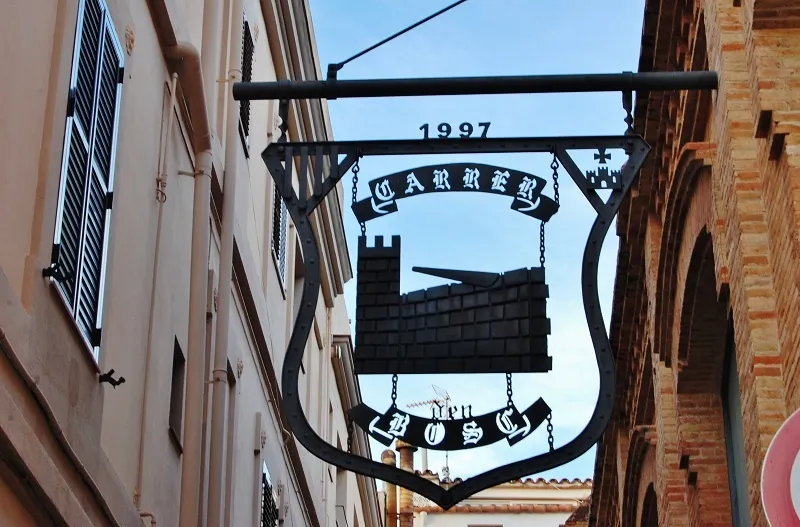
A first sign of the street’s uniqueness: a large iron shield hung in 1997 with the street’s flag created by Stämpfli—a wall and a cannon—to celebrate the 20th anniversary of the first Festa del Carrer d’en Bosc, which we will describe below.
Brief thematic summary of the festivals (1977–1986)
First (1977)
Presentation of the rescued, cleaned, and restored section of wall, on which the Catalonia flag was raised. A cypress tree, as a symbol of welcome, was planted next to number 6 of the street, where the former studio of painter Josep Vidal is located.
Second (1978)
A lead case was placed inside the wall containing the Sitges coat of arms, maps, records, a small malvasia wine jug, a bread stick, a bottle of tap water, and writings and documents from all the associations of Sitges.
Third (1979)
The light and sound show La muralla que parla was performed, telling the history of the wall and of Sitges, with text by Jacint Picas.
Fourth (1980)
A copy of the 18th-century cannon that defended the Baluard de Sitges, now in Vilanova at the Biblioteca-Museu Víctor Balaguer, was placed on site.
Fifth (1981)
The audiovisual documentary Sitges 1900, scripted by Ramon Planes, was presented.
Sixth (1982)
A large red hot-air balloon with the letters PAU Sitges 1982 was sent into the sky, containing a message for whoever found it, asking them to notify the Ajuntament de Sitges. A few months later, a letter arrived from Thailand explaining its discovery. In that same festival, to root the wish for peace, an olive tree was planted beside the Dr. Robert monument.
Seventh (1983)
La Festa del Carrer. A street flag was raised, two plaques were installed at both ends of the street, and a large circular bronze plaque with the handprints of the neighbors was placed. A cypress tree was replanted—still alive today—and the sardana El carrer d’en Bosc was premiered, composed specifically for the occasion by Jordi Panyella with lyrics by Josep Manuel Soler.
Eight (1984)
A rocket was launched with the names of the 12,000 Sitges residents registered that year.
Ninth (1985)
The walls of Sitges and Bern were twinned by exchanging a stone.
Tenth (1986)
On Sant Bartomeu Day, a shower of 12,000 carnations (one for each resident of Sitges) was dropped from a helicopter.
Information:
93 894 03 64
m.sitges@diba.cat