
Eduardo Arroyo
The work
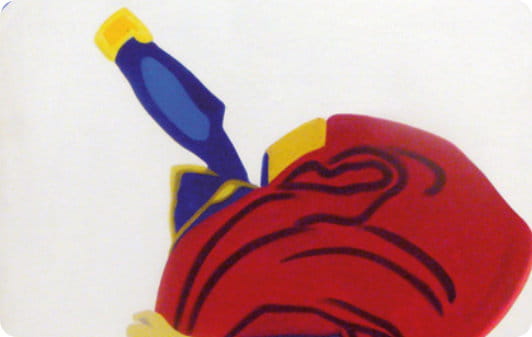
St. Bernard Tonnelet
1965
95 x 79 cm
Oil on canvas
The title El barrilete de San Bernardo (St. Bernard’s Barrel) is a direct reference to the name given to dogs trained to rescue travelers lost in the snow, fog, or storms. It was painted by Arroyo seven years after his voluntary exile to France, fleeing the oppressive cultural environment under Franco’s regime. The three colors that dominate the work, white, red, and blue, coincide with those of the French flag, symbols of liberty, equality, and fraternity.
The colors are flat: the white of the snow, the blue of the sky, the undulating silhouette of the mountains in the upper part. The only depth in the pictorial space is provided by the blue sleeve in the foreground, which protrudes, holding up the red volume like a protective blanket. It is difficult not to relate the work to his new situation in France.
The artist
Arroyo arrived in the French capital in 1958 as a writer and journalist with no artistic training. He had only done a few drawings and caricatures for magazines.
In Paris, without ever wanting to join a specific organization, he took positions linked to the working-class left, from the Soviet-aligned French Communist Party to the extreme left.
His friendship with the artists Gilles Aillaud and Antonio Recalcati, which began in 1963, was transcendental. With them he created the controversial work The Tragic End of Marcel Duchamp and, in 1966, the series Miró Redone.
In 1963, he exhibited The Four Dictators at the Paris Biennale, featuring portraits of Hitler, Mussolini, and their successors Franco and Salazar.
He met the critic Gérald Gassiot-Talabot, who promoted the Narrative Figuration group, emphasizing the critical aspect of this painting and differentiating it from American Pop Art and the French New Realists.
Narrative Figuration painting starts with objects and images viewed critically and integrates them into a narrative with a literary background and influences from cinema, comics, and even photo novels.
In May 1968, Arroyo collaborated in the Popular Workshop of the School of Fine Arts in Paris, making posters with revolutionary images and texts to distribute in the streets and avenues of Paris and keep the revolutionary flame alive.
That period ended immediately after the failure of the revolutionary experiment, and Arroyo moved to Italy, where he began a new phase of his painting between 1970 and 1972. With the death of Franco, he returned to Spain.