
Room 1 Room 2 Room 3
Erró. The Planetary Eye
Erró
Erró. The Planetary Eye
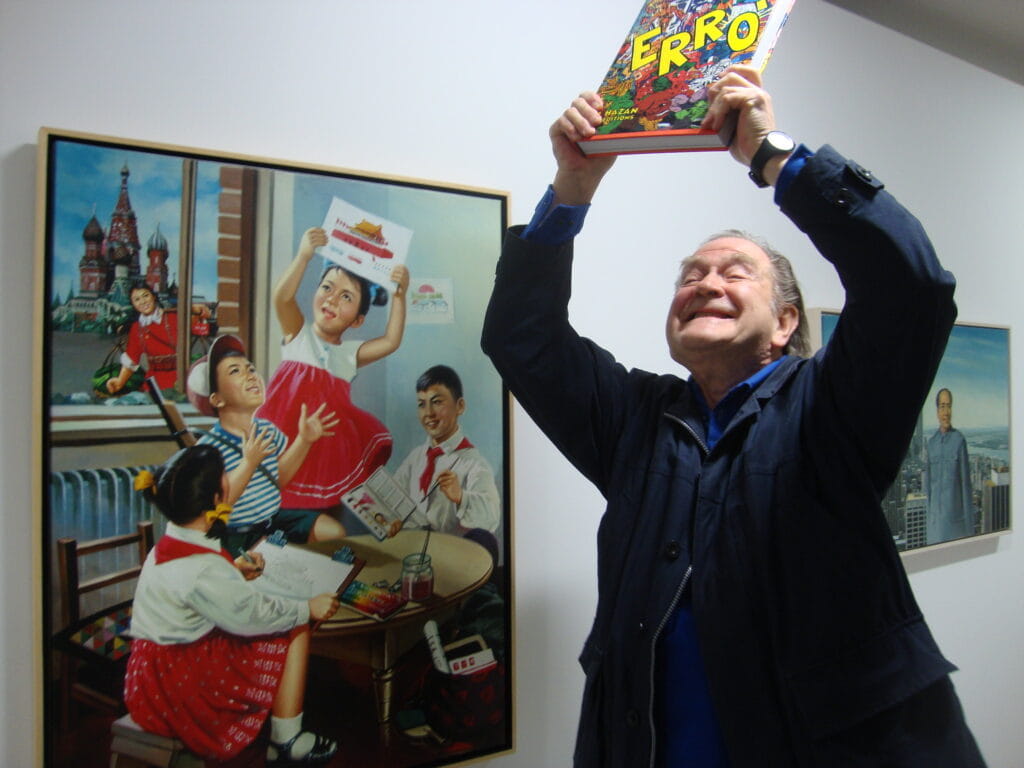
Erró. The Planetary Eye is the first exhibition that the Fundació Stämpfli has dedicated to an artist from its collection. An internationally recognized painter, Erró has developed a personal language that ironizes the confusion of today’s world. The exhibition presents in Espais 2 and 3 a selection of paintings and collages from some of his most emblematic series such as The Political Paintings, Le tour du monde de Mao, Les lettres d’amour japonais and Les femmes fatales. These works highlight the main characteristics of his practice, centered on the manipulation of thousands of images taken from the mass media, comics, advertising, or art history.
The exhibition is framed within the context of the permanent collection of the Fundació Stämpfli, which includes among its holdings an important group of works linked to Figuration narrative, a movement that emerged in Paris in the 1960s as a response to American pop art. Espai 1 brings together a selection of paintings by some of its most significant representatives, such as Eduardo Arroyo, Jacques Monory, Peter Stämpfli, and Erró himself, among others.
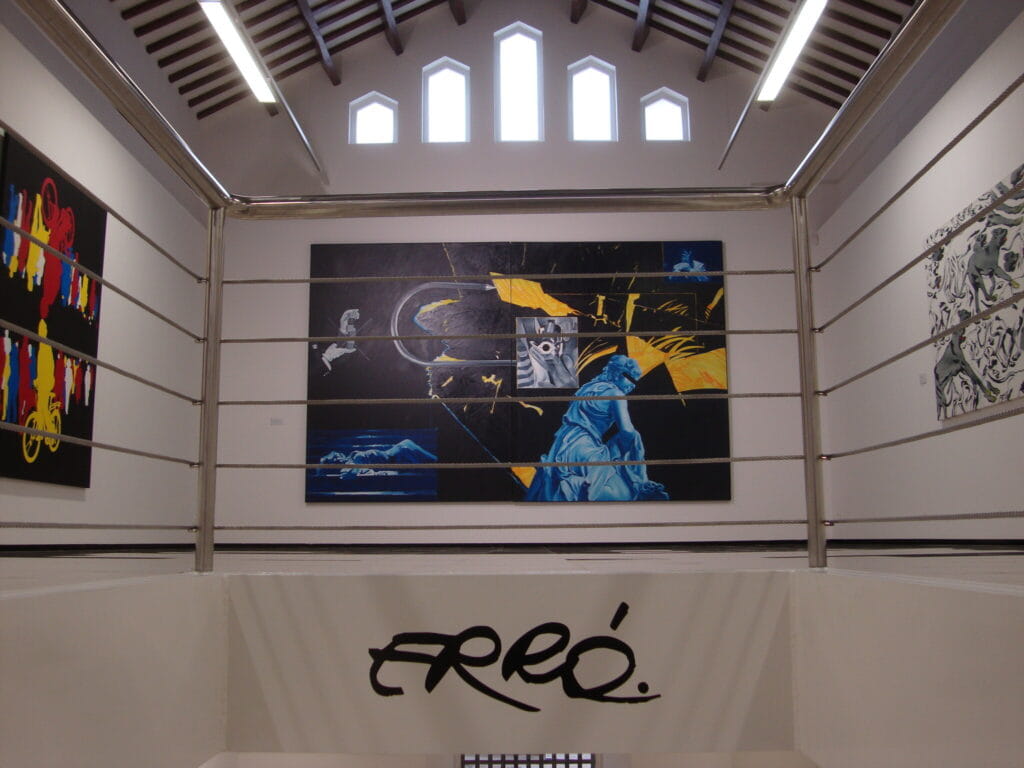
Works from the Foundation’s collection related to figuration
The 11 artists gathered in this room share the same connection with figurative painting, whether it is images of reality stylized, cut, and recomposed (Peter Klasen); enlarged details that transfigure it (Peter Stämpfli); dreamlike representations (Jacques Monory); social themes (Antonio Seguí); futuristic vision (Erró); or allegorical figure (Bernard Rancillac).
‘The Political Paintings’
Accustomed to working in thematic series, Erró produced over several years the paintings of The Political Paintings (1967–1996), which form a kind of epic of our recent history. Playing with the overwhelming accumulation of images, Erró questions reality in order to offer a unique perspective on some of the most significant political and social events of our time.
‘Le tour du monde de Mao’
In the early 1970s, Erró gathered extensive documentation on the propaganda of the People’s Republic of China, which inspired one of his most famous series, in which he portrays Mao in different cities around the world. The result of this work is a group of unusual paintings where the juxtaposition of unrelated images produces a visual shock not devoid of irony.
‘Les femmes fatales’
In 1963, while living in New York, Erró began incorporating comics into his work, thus sharing with pop art artists their interest in popular culture. Since that period, comics have been a recurring reference in his creation. The series Les femmes fatales is part of a tribute to American comics, particularly to superwomen, the myth of the aggressive woman of Western civilization.
‘Les lettres d’amour japonais’
This series of oils occupies a unique place in Erró’s career, although it perfectly aligns with his interest in storytelling through painting. In 1970, he became fascinated by an old book found in Japan that contained letters and photographs of young couples. From this documentation he created a series of oils that evoke the relationships of love and friendship among these mysterious heroes. Later, he discovered that the protagonists were leading intellectuals who, in the 1920s, rebelled against the sclerosis of Japanese society.
‘Los collages’
From the beginning of his career, Erró has been a virtuoso of collage, which he creates from an impressive range of materials taken from magazines, political propaganda, catalogues, comics, illustrated dictionaries, etc. In the tradition of the Surrealists, Erró invents surprising associations by mixing images with no apparent connection between them, so that each composition provokes in the viewer a kind of electric shock. Conceived as autonomous works, these collages also serve as models for his paintings.
Relationship with art
Erró has always maintained close ties with art history, offering in his paintings a new reading of well-known works to create powerful and often subversive images. Joan Miró, Henri Matisse, and especially Fernand Léger are among the artists who have inspired him.