

Room 1 Room 2 Room 3
Mon Exposition
Peter Stämpfli
Mon Exposition
Since the inauguration of the Stämpfli Foundation in 2011, temporary exhibitions had been organized with works from the Foundation’s own collection and anthological presentations of the artists who made it possible.
In 2021, Peter Stämpfli decided that the time had come to hold his own temporary exhibition and titled it Mon Exposition, a way of saying “now it’s mine.”
It was composed of the installation Black Structures on Color from 1998 in Room 1 and the project Stained Glass Prepared for the Gothic Windows of the Abbey of Châteauroux, France, 1988, exhibited in Room 3.
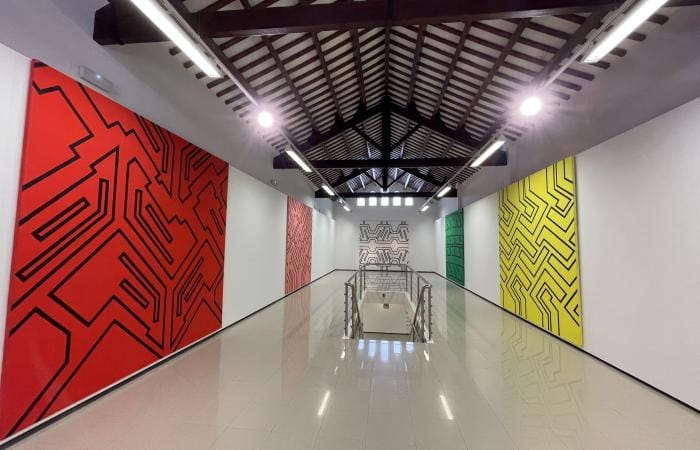
Black Structures on Color
In 1998, Peter Stämpfli was invited to exhibit at the Palais des Congrès in Paris, in the large entrance hall to the Auditorium.
He created a series of 5 large-format works, five squares of 3 meters per side, untitled, later named Black Structures on Color. Although each is based on the geometric design of different real tire treads, the five different colors —red, pink, white, green, and yellow— reinforce the abstraction of the fine linear structures.
At the Stämpfli Foundation, the works occupied the main hall with an installation of 5 canvases that were colloquially referred to as the 5 colors.
For the first time since 1998, they were presented together in a new installation in Sitges, where color and the tire mark explore new possibilities of Stämpfli’s sole theme: the tire, interacting with the void, the white walls surrounding each color.
The Stained Glass of the Abbey of Châteauroux
In 1988, the Municipality of Châteauroux, France, invited Peter Stämpfli to a solo exhibition in the Gothic abbey nave of the 13th-century Cistercian Abbey of the Cordeliers.
He created 7 linear studies in India ink and 7 gouaches cut from painted paper and glued on canvas measuring 280 x 125 cm, as a 1:2 scale model. The window span measures 560 x 250 cm.
The project received great acclaim, although it could not be realized since the abbey has been, for decades, a space for various cultural activities and exhibitions. It remained open as a surprising possibility offered by Peter Stämpfli to the city of Châteauroux.
Opposition/Complement
From the 1960s to the beginning of the 21st century, artists have continually expanded the limits of thematic exploration and the development of all kinds of techniques. The 14 works exhibited challenge the viewer to discover the aspects of confrontation or complementarity between them.
From the 1960s to the early 21st century, artists have continued to push the boundaries of thematic exploration and the development of all kinds of techniques. In this room we find the following examples:
- The minimalist repetition of Pierrette Bloch.
- Totemic sculpture with elemental materials by the Belgian Mark Brusse or the Catalan-American Tom Carr.
- Language games by Philippe Cazal.
- Optical effects by the Venezuelan Carlos Cruz-Díez.
- The persistence of classical world iconography by the Italian Marco Del Re.
- Assemblage of found objects by Jean-Jacques Lebel.
- Experimentation between support and mark by Jean-Michel Meurice.
- Geometric abstraction by Olivier Mosset.
- Primitivism and gesturality by Jean-Michel Sanejouand.
- The poetics of fragmentation and rupture by Gérard-Titus Carmel.
- Eastern philosophical thought and the water drop by the Korean Kim Tschang-Yeul.
- War and destruction by the Serbian Vladimir Velickovic.
- Torn advertising posters by Jacques Villeglé.