

How it all was born
At the event commemorating the 15th anniversary of the Stämpfli Foundation — born from friendship, trust in Sitges and an interest in art — Peter Stämpfli, Pere for the people of Sitges, recalled the origins of the project in this text published on May 9th, 2025, in the emblematic weekly newspaper L’Eco de Sitges
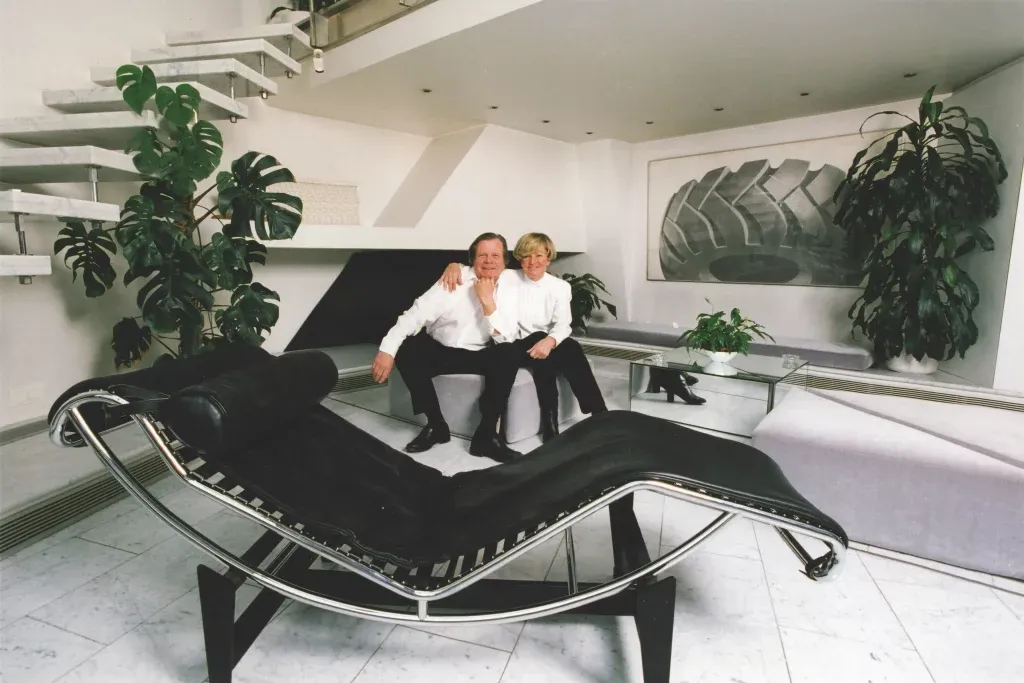
Friends from Sitges.
The other day I was walking through the streets of Paris when suddenly a man stopped me and asked: “You’re from Sitges, right?” I replied with some suspicion: “If you’re from the police or the tax office, please don’t talk to me.” But he answered: “No! Not at all! I’m from Sitges and I recognise you from having seen you there.” Then, more at ease, I replied: “Delighted! What can I do for you?” “Nothing,” he said. “I just enjoy talking about our town, which we love.” “Well, so do I,” I replied. “We’ve been living there for more than 60 years.” And he continued: “A lot has been done in Sitges, but you’ve created an art foundation. How was it possible to gather so many artists to build such a large art collection?” “Friendship,” I replied. “In Paris, many artists from all over the world circulate. We met several of them and became friends. And above all, trust in Sitges and an interest in art.” Then he asked: “How did you come up with the idea of creating an art foundation, and when did you start?”
It all began in 2005, when I was invited to take part in a round table. Everyone was talking about projects and the future of Sitges. My speech was brief: “Sitges has everything: film, poetry, jazz, painting, music and theatre festivals. Popular celebrations, congresses, concerts. You have three museums — the Cau Ferrat, the Maricel and the Romantic. You have Rusiñol! And so many priceless works in his Cau, such as El Greco, Picasso, Gargallo and others. You have a magnificent and unique collection of 19th- and 20th-century works. You have everything. But… you’re missing something!: you’re missing international contemporary art.” The mayor at the time, Jordi Baijet, replied: “I would love to provide Sitges with a museum of international contemporary art, but I don’t know what works I should buy and I don’t have the money to do it.” And I answered: “If you place your trust in Anna and me, within a year we will bring you a collection of international modern art to Sitges.” I immediately realised the great responsibility that had fallen upon me.
Back in Paris, where I work, Anna and I got down to business: phone calls, many phone calls, to explain our ambitious project and persuade our artist friends, art critics and museum directors to believe in it. Many visits to their studios, which, by the way, were a wonderful and very enriching experience for me, to explain what Sitges was and what we wanted to achieve there with this ambitious project. We also asked our notary friend to prepare the foundation deed and donation documents, and we asked Mayor Baijet for a letter of support stating clearly that this was a project with a future and for Sitges. Little by little, I realised the scale that the initiative was taking, occupying us every day for months. In fact, between 2006 and 2011 I spent countless hours creating the collection and imagining and building the building.
It was difficult to persuade some of the artists, because every piece in the collection is a donation to our Foundation and therefore to the town of Sitges. Not a single one was purchased. And little by little, the artists began to trust us. The first stone had been laid. One year later, full of enthusiasm, I was able to inform the mayor — who, incidentally, often confessed his doubts about the outcome of the project — that we already had the foundation, part of the collection and two buildings in Carrer d’en Bosc in which to place the works. We held a press conference at the Town Hall to present it, and Mayor Baijet said: “To house the works, I’ll give you the old fish market, which is no longer of any use, as we already have a new one.” I didn’t thank him, but I was very pleased, because my project was for the town of Sitges and this response enhanced it. But the mayor still had doubts about the magnitude of the work and didn’t want to give his full backing until he saw the artworks physically in Sitges.
And so it was. Once we had gathered most of the collection, we wanted to bring it to Sitges and thought of presenting everything we had collected to the town. In the summer of 2009, we conceived an exhibition at the Miramar building, because the works on the foundation buildings were advancing slowly. The mayor, the culture councillor Gabi Serrano and the museum director Toni Sella set a date: the end of March 2010. We began inviting the donor artists and even the Catalan Minister of Culture (who received us in his office on La Rambla on 26 August 2009) to join us on that solemn day. And indeed, the collection arrived in Sitges in a large truck transporting the works from Paris. When it reached Aiguadolç, the local police awaited it and escorted it to La Torreta, and from there our dear Isidre Panyella set off 21 salute mortars in welcome on behalf of Sitges.
On Saturday, March 20th, the first part of the collection was inaugurated in the Miramar Building, and all the donor artists were invited to attend the event. They all accepted and travelled from France, Italy, Switzerland, Scotland and other countries, and they stayed at the Hotel Calipolis. It had been a long time since Sitges had gathered so many renowned artists in a single day! The evening before we held a dinner of thanks at La Fragata, and on the night of the inauguration another dinner at Pic-Nic, where the Matas brothers welcomed us with their customary warmth. Needless to say, all our friends were delighted to be with us, proud of what Anna and I had accomplished, and they all fell in love with Sitges and fondly remember those days. The exhibition was a public success and remained open until May 23rd. We organised several guided tours, some by Serge Lemoine and others by Daniel Giralt-Miracle, both very dear friends. The Town Hall published a magnificent catalogue in two versions, one in Catalan and French and the other in Spanish and English, which still today serves as an excellent presentation.
And then, back to work. The Town Hall gave us the empty fish market building, just four dirty walls. And I committed myself to turning those four walls into a museum, also using the studio I had in the part of the house called Can Mec, which I had lent to the Grup d’Estudis for their cultural activities. The construction took more than a year and finished at the end of 2010, always with the collaboration of Josep Maria Coll Guinart, the architect friend who accompanied us throughout this project. On Sunday morning, January 30th, 2011, we hoisted the Foundation’s flag over the former fish market, with a large attendance and much ceremony, to inaugurate the facilities. A few weeks later, we already had the first part of the works installed — all donated freely and with great generosity by the artists or their heirs — to the town of Sitges through the foundation.
The rest you already know. In early 2016 we began major works at Carrer d’en Bosc 5 and 7, known by everyone as “Can Serramalera”. We demolished the interior, built a basement and finally, on October 13th, 2018, we connected the two buildings, which we presented to the public empty, without artworks. In the new building there are three new exhibition rooms where, since February 2019, I have been able to offer Sitges a selection of my work.
Today we are happy and proud to have brought international contemporary art to Sitges, and we thank Sitges and the people of Sitges for the trust they have placed in us all these years, for enriching the culture of our town, and for having accompanied us in every event and exhibition held at the foundation. In my life I have only had two loves: Anna and Sitges.
The man from Sitges who had stopped me on the streets of Paris listened intently. “Thank you, Peter — Pere, as we call you,” he said. Then, telling me that he had visited the international contemporary art and my works exhibited there, he asked me: “Just one question: how do you situate your work within contemporary art?” And I replied: “They have placed me within Pop Art and Narrative Figuration — even saying: ‘Stämpfli is a figurative artist who makes abstraction’ and ‘Stämpfli is an abstract artist who makes figuration.’ My work is a constant, an analysis, a dictionary of everyday life: the everyday gestures and the objects that surround us, up to the symbol of our era: the automobile. From the steering wheel to the bodywork, from the bodywork to the wheel, from the wheel to the tyre and to the monumental enlargement of its structure in all forms, colours, techniques and dimensions, arriving finally at its negative: the imprint. What do you think?”.
Peter Stämpfli
Paris
Spring of 2025